The Proper Grip
A proper knife grip is the foundation of every successful cut in the kitchen. It’s not just about comfort it’s about control, safety, and efficiency.
Why Your Knife Grip Matters
Holding your knife the wrong way can lead to more than just sloppy cuts. Poor grip leads to quicker fatigue, higher chances of injury, and far less precision in the kitchen. If your cuts are uneven or your wrist feels strained after prep, your grip may be to blame.
Benefits of a strong, proper grip:
Increases precision and control
Reduces hand and wrist fatigue
Helps you cut faster and safer
Mastering the Pinch Grip
The “pinch grip” is a simple yet essential technique used by professional chefs and now, more home cooks. It gives you direct control over the blade, unlike holding the knife by the handle alone.
Here’s how to do it:
Pinch the blade of the knife where it meets the handle using your thumb and index finger.
Wrap your remaining three fingers around the handle.
Keep your wrist neutral and relaxed.
This gives you better leverage and sensitivity with each cut. It might feel awkward at first, but after a few slicing sessions, it’ll become second nature.
Common Mistakes (And Quick Fixes)
Make sure you’re not falling into these frequent grip traps:
Mistake: Holding the knife entirely by the handle like a club.
Fix: Shift your grip forward and pinch the blade for more control.
Mistake: Splaying out your fingers or placing your index finger on top of the blade.
Fix: Keep fingers tucked and guided by the food not flaring out for balance.
Mistake: Gripping too tightly.
Fix: Hold the knife firmly, but not tensely. A relaxed grip improves flow and reduces fatigue.
Small changes in how you hold your knife can have a big impact on how you prep your ingredients. Before chasing speed, start with control.
Mastering the Rock Chop
If you’re serious about getting faster in the kitchen without sacrificing precision, the rock chop is your go to technique. It’s simple in concept: keep the tip of the knife in contact with the board as you raise and lower the handle in a rocking motion. The result? Clean, controlled cuts that move fast and stay accurate. No wild swings. No bruised herbs. Just rhythm and repeatability.
To make the most of this motion, your tools matter. Choose a chef’s knife with a curved belly 8 to 10 inches is standard for most hands. Avoid flat bottomed blades for this. You want one that makes that smooth arc across the board. Pair it with a sturdy wooden or rubber cutting board. Glass or stone might look good, but they’ll dull your blade fast. Skip them.
As for safety, here’s the deal: keep your fingers curled under your guide hand (the one holding the food), and let your knuckles act as a fence. This protects your fingertips and gives the knife something to track against. Don’t force the blade let it do the work. And keep it sharp. A dull blade slips more easily, which means cuts in all the wrong places.
The rock chop isn’t fancy. But it’s foundational. Nail it, and everything else starts to click.
Consistent Cuts = Even Cooking

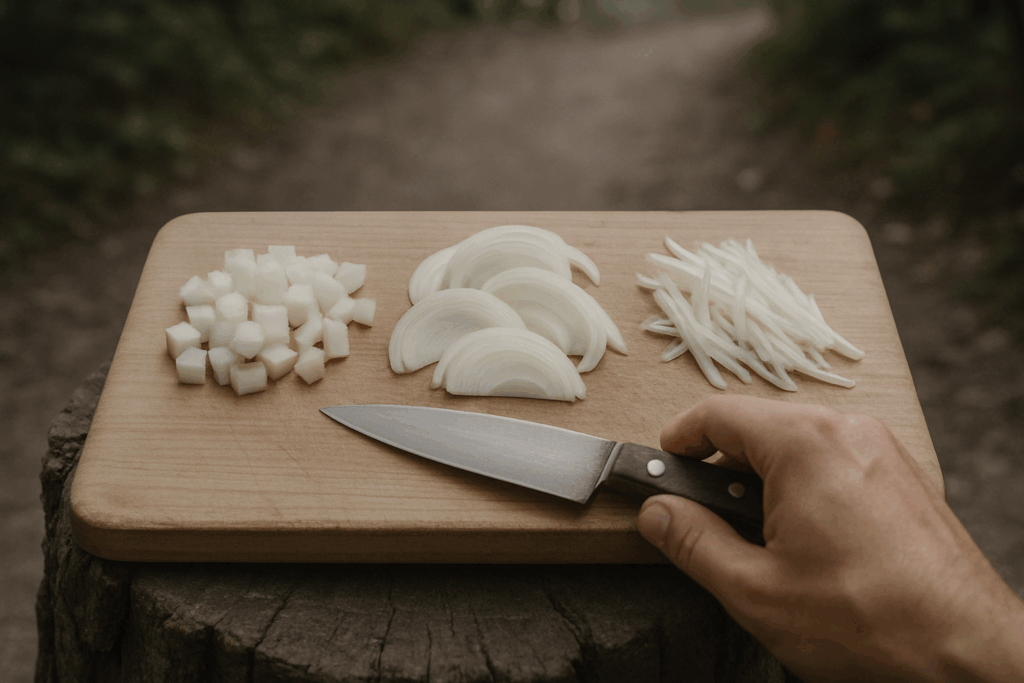
Uniform slicing isn’t just a flex it’s functional. When your ingredients are roughly the same size, they cook at the same rate. That means no half burnt, half raw carrots or onions releasing flavor at random. Consistent cuts equal even heat distribution and predictable timing. In short: your food tastes better, and your timing gets tighter.
The key is mastering a few core knife techniques. Dicing gets you compact cubes perfect for sautéing. Mincing breaks things down finer great for garlic, ginger, or anything where you want flavor without big chunks. Julienne is all about slim, matchstick cuts, ideal for stir fries and crisp salads. And chiffonade? That’s your go to for leafy herbs or greens roll them, slice them, and you’re done.
The bonus isn’t just texture or taste. Better knife work makes your plate look polished, even if it’s just Tuesday night dinner. A pile of neatly julienned bell peppers just hits different. Train your hands, keep the rhythm, and consistency becomes second nature.
How to Prep More, Waste Less
Maximizing your ingredients isn’t just about being thrifty it’s also about making smarter choices in the kitchen. Good knife skills can save time, improve flavor, and stretch your grocery budget further.
Get the Most from Fruits and Vegetables
It’s easy to lose half an onion or waste a lot of carrot tops if you’re not cutting with intention. To get the most from your produce:
Learn proper peeling and trimming techniques to minimize waste and preserve edible portions.
Use every part turn broccoli stems into slaw, save herb stems for stocks, or chop beet greens for sautéing.
Cut with precision to reduce leftover scraps.
Trim Proteins Without Losing Value
Whether you’re working with chicken thighs or a whole fish, knowing where and how to cut makes a big difference.
Remove fat and silver skin cleanly without cutting away good meat.
Debone with purpose, not guesswork, preserving every ounce of usable protein.
Slice against the grain for better texture and flavor when serving.
Save Time and Money with Smart Knife Work
Your knife can be one of your most efficient tools if you’re using it correctly.
Batch prep vegetables at the start of the week to save cooking time later.
Learn common prep shortcuts, like segmenting citrus or breaking down a whole chicken.
Invest in technique, not gadgets a sharp knife is often faster than any single use tool.
Getting intentional about how you prep doesn’t just make you faster it makes your cooking smarter, cleaner, and more efficient.
Keeping Your Knives Sharp (and Why It Matters)
A sharp knife is a safe knife. That’s not just something chefs say it’s a simple fact. Dull blades force you to push harder, which makes slips and accidents more likely. A sharp edge glides where you want it to go. Less pressure. More control. Cleaner cuts.
Honing and sharpening aren’t the same thing. Honing realigns the blade’s edge. It’s like brushing your knife’s teeth it should happen often, ideally every few uses. Sharpening, on the other hand, grinds down a new edge. That’s heavy duty maintenance and should only be done when the blade starts to drag, usually every few months depending on use. Use a honing rod for regular upkeep. For sharpening, a good whetstone or a reputable sharpening service will do the job.
Proper storage matters, too. Tossing knives in a drawer is a fast track to ruined edges and nicked fingertips. Invest in a magnetic strip, blade guards, or a slotted knife block. Keep them dry, and never run them through the dishwasher.
As for the best tools in 2026? Look for ceramic honing rods for less wear and tear, water cooled sharpening systems for precision without overheating the metal, and hybrid electric/manual sharpeners that let you fine tune by hand without needing full on whetstone skills.
Take care of your blade, and it’ll take care of your fingers.
 Samuellle Rosantiere is the kind of writer who genuinely cannot publish something without checking it twice. Maybe three times. They came to cooking tips and techniques through years of hands-on work rather than theory, which means the things they writes about — Cooking Tips and Techniques, Delicious Recipe Ideas, Ingredient Spotlights, among other areas — are things they has actually tested, questioned, and revised opinions on more than once.
That shows in the work. Samuellle's pieces tend to go a level deeper than most. Not in a way that becomes unreadable, but in a way that makes you realize you'd been missing something important. They has a habit of finding the detail that everybody else glosses over and making it the center of the story — which sounds simple, but takes a rare combination of curiosity and patience to pull off consistently. The writing never feels rushed. It feels like someone who sat with the subject long enough to actually understand it.
Outside of specific topics, what Samuellle cares about most is whether the reader walks away with something useful. Not impressed. Not entertained. Useful. That's a harder bar to clear than it sounds, and they clears it more often than not — which is why readers tend to remember Samuellle's articles long after they've forgotten the headline.
Samuellle Rosantiere is the kind of writer who genuinely cannot publish something without checking it twice. Maybe three times. They came to cooking tips and techniques through years of hands-on work rather than theory, which means the things they writes about — Cooking Tips and Techniques, Delicious Recipe Ideas, Ingredient Spotlights, among other areas — are things they has actually tested, questioned, and revised opinions on more than once.
That shows in the work. Samuellle's pieces tend to go a level deeper than most. Not in a way that becomes unreadable, but in a way that makes you realize you'd been missing something important. They has a habit of finding the detail that everybody else glosses over and making it the center of the story — which sounds simple, but takes a rare combination of curiosity and patience to pull off consistently. The writing never feels rushed. It feels like someone who sat with the subject long enough to actually understand it.
Outside of specific topics, what Samuellle cares about most is whether the reader walks away with something useful. Not impressed. Not entertained. Useful. That's a harder bar to clear than it sounds, and they clears it more often than not — which is why readers tend to remember Samuellle's articles long after they've forgotten the headline.